Lab Companion Temperature Test Chamber: High-Temperature Reliability Testing Practice for Data Center Servers and Multi-Bay NAS
Sep 05, 2026
1. Necessity of Full-Server Temperature Cycling Testing
1.1 Component-Level Qualification Does Not Equal System-Level Reliability
CPU, memory, SSD, PSU and other individual server components are factory-certified with clear temperature tolerances and reliability ratings. However, once integrated into a complete server or NAS system, the actual internal thermal environment changes significantly. System chassis airflow layout, mutual heat interference between densely arranged components, and dynamic fan speed adjustment often create local hotspots. These factors may push component operating temperatures beyond their rated specifications.
For this reason, real full-system temperature testing under powered and loaded conditions is mandatory. Component datasheets and software thermal simulation cannot replace physical environmental chamber verification, which is essential to validate coordinated system stability.
1.2 Coupled Thermal Effects in Server and NAS Chassis
Under full load, server CPUs and GPUs generate intense heat, which raises the ambient air temperature inside the chassis. Heated airflow passes through hard drives, memory modules and power units, elevating the overall operating temperature of the entire system. This thermal coupling effect is more severe on multi-bay NAS devices, where tightly packed HDDs/SSDs amplify heat accumulation during continuous write workloads.
High-temperature testing simulates extreme data center failure scenarios, including air conditioning outage and rack inlet temperature surge, with a test range of +40℃ to +55℃. During testing, engineers monitor real-time temperature readings of all key components to detect thermal throttling, overheating protection, performance degradation or system errors. For multi-bay NAS units, special attention is paid to write amplification and SMART parameter variations under high-temperature high-load conditions.
2. Core High/Low Temperature Test Items for Servers and NAS
2.1 Long-Duration High-Temperature Burn-In Test
High-temperature continuous burn-in is the foundation of server system reliability validation. The full system is placed in a constant temperature environment of +40℃ to +55℃ and runs sustained CPU, RAM and disk stress tests to simulate maximum operational load. Standard test duration ranges from 48 to 72 hours.
Key monitoring metrics include component temperature, power consumption, fan speed and system logs. Pass criteria cover no system crash, no unexpected reboot, no hardware error logs, no excessive thermal throttling, and no degradation in disk health status. For rack-mount servers, inlet/outlet temperature difference and airflow efficiency are also verified to eliminate thermal dead zones and short-circuit airflow risks.
2.2 Multi-Bay NAS Write Amplification and SMART Monitoring
Multi-bay NAS devices with 4 to 24+ drives operate under RAID-based continuous write workloads, resulting in concentrated and mutually superimposed heat generation. High ambient temperature significantly increases SSD write amplification, accelerating NAND flash aging and shortening service life. Therefore, NAS high-temperature testing focuses on two critical indicators: write amplification factor and drive SMART health status, including disk temperature, bad block count, wear leveling and unexpected power loss records.
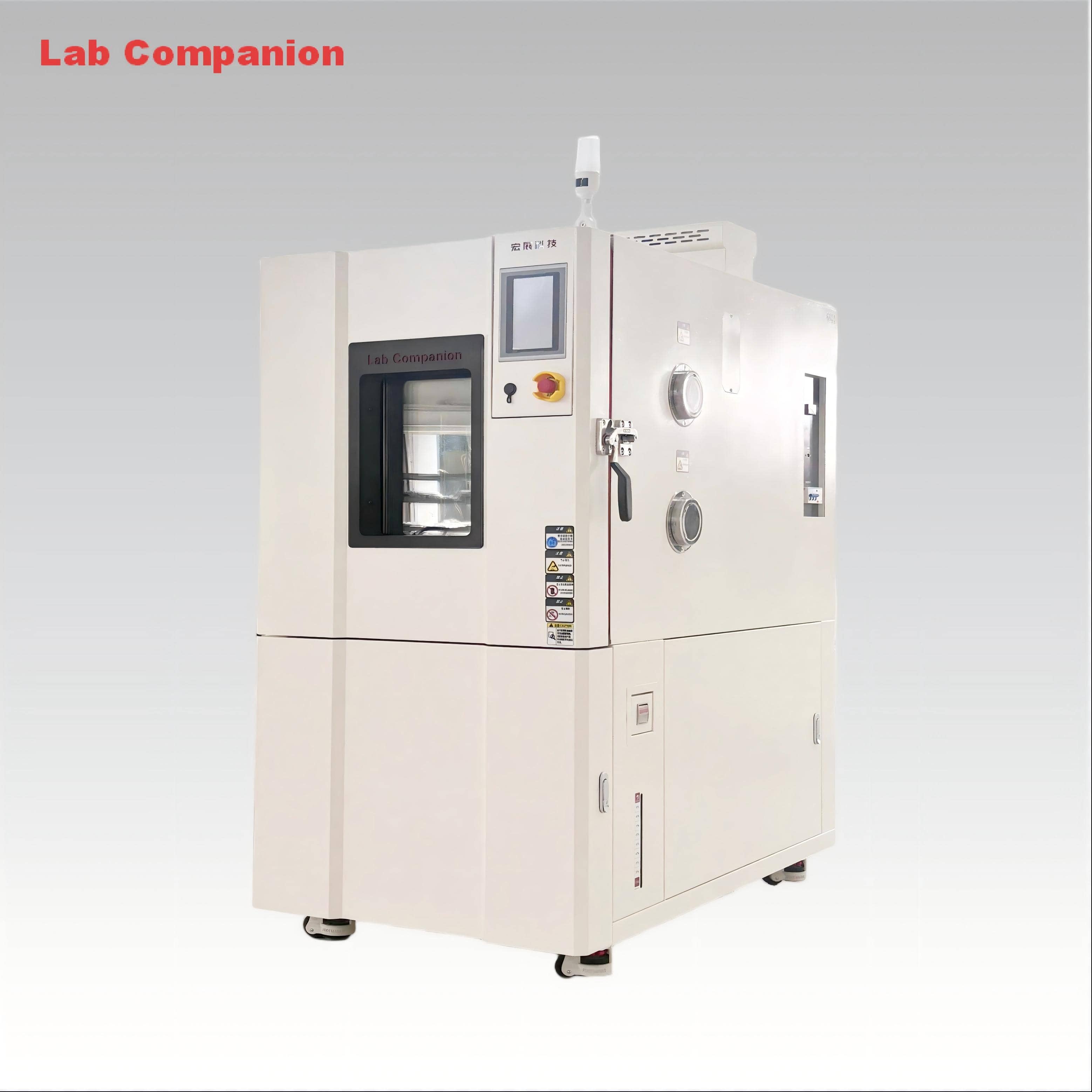
Lab Companion large-capacity temperature chambers can accommodate complete NAS units and reserve external cable ports for real-time drive data collection. The system automatically records full-process temperature curves and SMART changes, providing complete and traceable test data for chassis thermal design optimization and fan control strategy iteration.
2.3 Low-Temperature Startup and Gradual Temperature Adaptation Test
Although data centers maintain constant indoor temperature, servers and NAS devices are exposed to low temperatures during transportation, warehousing and unexpected facility downtime. Low-temperature startup testing is conducted between 0℃ and -20℃. After sufficient temperature stabilization, the system is powered on to verify normal BIOS initialization, OS booting, RAID identification and disk mounting.
Gradual temperature variation testing simulates slow data center temperature fluctuations. The chamber temperature rises or falls stepwise with staged load operation, to verify fan response accuracy, system performance stability and thermal management adaptability. This effectively detects hysteresis or over-adjustment defects in firmware thermal control logic.
2.4 International Compliance Standards
All testing procedures comply with globally recognized standards:GB/T 2423 series, IEC 60068-2-1 (low temperature) and IEC 60068-2-2 (high temperature). Lab Companion test chambers are manufactured in accordance with GB/T 10592-2023, ensuring qualified temperature fluctuation, uniformity and deviation indicators to guarantee repeatable and credible test results.
3. Lab Companion Chamber Selection & Technical Advantages
3.1 Full Capacity Range for All Server and NAS Form Factors
Lab Companion provides a complete volume lineup: 34L / 64L / 100L / 180L / 340L / 600L / 1000L / 1500L, covering all mainstream device sizes. 1U/2U rack servers fit 340L+ models; 4U/5U tower servers and multi-bay NAS recommend 600L+ chambers; full rack testing supports 1000L+ or customized walk-in solutions.
Large-capacity models adopt enhanced heating and refrigeration systems to maintain stable temperature even with high-thermal-capacity full-system samples. The SUS304 stainless steel inner chamber features high load-bearing capacity and customizable layered brackets to fit server and NAS dimensions.
3.2 Ultra-Wide Temperature Range and High Precision Control
Standard temperature coverage spans-70℃ to +150℃, with optional customized low-temperature limits (-20℃ / -40℃ / -60℃), fully covering all conventional and extreme temperature test requirements for data center hardware.
Precision performance: temperature fluctuation ≤±0.5℃, temperature deviation ±2.0℃, temperature uniformity ≤2.0℃. Equipped with BTHC balanced temperature control system, the chamber realizes dynamic hot-cold balance, avoiding temperature overshoot and oscillation. Stable and uniform internal temperature ensures consistent and repeatable test data without abnormal fan speed jitter or system performance fluctuation.
3.3 Gentle Temperature Ramp Rate and Optimized Airflow Design
Standard ramp rates of 1℃/min and 3℃/min support gradual temperature change testing, which simulates real data center temperature drift. Compared with rapid thermal shock chambers, the gentle temperature transition better verifies the accuracy and stability of the device’s native thermal management algorithm.
The forced convection airflow design realizes full-chamber uniform temperature distribution. Air circulation and return pathways eliminate internal thermal dead zones. Test airflow direction can be adjusted to match actual rack inlet/outlet airflow, ensuring test scenarios highly consistent with real operating environments.
4. Global Delivery & After-Sales Service Policy (Overseas)
4.1 R&D and Customization Capabilities
Lab Companion is a national high-tech enterprise with 21 years of experience in environmental testing equipment R&D and manufacturing. The Dongguan production base supports standard mass production and non-standard customization, including oversized chambers, reserved test wiring holes, multi-channel data acquisition and custom load-bearing fixtures to meet personalized server and NAS testing demands.
All equipment undergoes strict factory calibration and full-temperature-domain uniformity testing before delivery to ensure stable and accurate performance under formal test conditions.
4.2 Overseas After-Sales Service Mechanism
Note for overseas customers: On-site door-to-door service is not available in overseas regions.
To guarantee stable equipment operation for global users, Lab Companion provides a standardized overseas after-sales system: free genuine spare parts supply within the warranty period + full-cycle online technical guidance. Our professional overseas technical team supports remote equipment commissioning, operational training, fault diagnosis and troubleshooting guidance. Users can complete daily calibration, routine maintenance and minor fault recovery under online instructions, effectively avoiding long downtime.
4.9 Global Application Cases
Lab Companion environmental test chambers are widely adopted by global enterprises, university laboratories and research institutions in server, NAS, new energy and semiconductor industries. Overseas and domestic clients include power research institutes, automotive electronic enterprises and top universities.
Field feedback verifies that Lab Companion large-capacity chambers maintain excellent temperature stability even with full server/NAS loads. The programmable controller stores multiple test recipes for one-click switching of different test standards. For multi-bay NAS high-temperature testing, the equipment accurately captures long-duration write performance and disk health data, helping clients optimize thermal design and improve product reliability in high-temperature data center environments.
5. Conclusion
As global data center computing density continues to rise, full-system temperature reliability has become a core indicator of data center hardware quality. Full-server and NAS high/low temperature testing effectively verifies coordinated thermal stability under real loaded conditions, which cannot be replaced by single-component testing.
Lab Companion test chambers deliver reliable hardware support for data center hardware reliability verification through full-size coverage, ultra-wide and high-precision temperature control, and industry-matched airflow simulation. With strong customization capability and professional overseas remote after-sales support, Lab Companion provides global clients with a complete solution covering model selection, customized manufacturing, remote commissioning and lifelong technical support.
Stable and standardized full-system environmental testing helps global hardware manufacturers optimize thermal design, improve environmental adaptability, and reduce field failure risks, empowering high-quality and reliable development of global data center infrastructure.
Mehr lesen






 Ein Angebot bekommen
 IPv6-Netzwerk unterstützt